There are many different types of garbage bags on the market. Some bags are biodegradable, and some are compostable, but what’s the difference? There is a lot to know about these two types of garbage bags, making it difficult to choose. So you’re thinking about getting a new set of garbage bags? We’ve got your back with this article, which discusses the benefits and drawbacks of each type. If it seems like something best suited to your needs, click through now!
If the material is compostable, it means that under composting conditions (heat, moisture, oxygen, and microorganisms), it will completely break down into CO2, water, and nutrient-rich compost within a specific time frame. If the material is biodegradable, the composition is based on conventional plastics with specific additives and degradable ingredients that do not fully degrade.
-

compostable trash bags manufacturer
What is a compostable trash bag and what is a biodegradable trash bag?
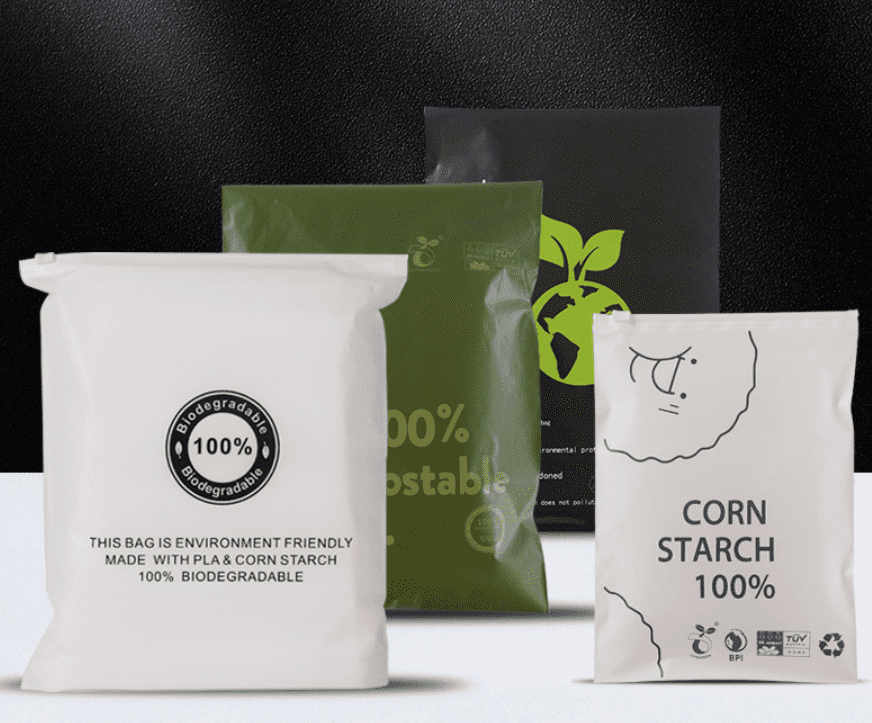
Compostable trash bags are a great alternative to plastic. They are made from corn starch, tapioca root, potato starch, and other fully degradable resins.
Biodegradability is an inherent property of a material or product that results from the action of naturally occurring microorganisms such as bacteria, fungi, and algae. The process produces water, carbon dioxide, and biomass. No additives are required, and no debris remains in the environment.
Composting is enhanced biodegradation under controlled conditions (e.g., temperature, humidity, and the presence of microorganisms). The requirements are clearly defined in internationally recognized standards (e.g., EN 13432 or ISO 18606).
Many different terms represent processes, but not all occur at the same rate. For example, “biodegradable” does not necessarily mean how quickly it breaks down or return to Earth – this can vary depending on conditions. For example, wood is biodegradable, but the wood structure does not decompose and can be passed down through generations. Trees are biodegradable but can survive for hundreds of years.
The world’s regulatory agencies are trying to silence the term “biodegradable” not to confuse consumers and industrial composters. Instead of using this word, they promote a more accurate but less catchy “Compostable” symbol that will guide you through your recycling journey with ease!
Material Differences:
Compostable garbage bags: based on corn starch/potato starch, cassava, etc., with a mix of PBAT, PLA fully biodegradable materials. If the material is compostable, this means that under composting conditions (heat, moisture, oxygen, and microorganisms), it will completely decompose into carbon dioxide, water, and nutrient-rich compost in a given time.
Biodegradable garbage bags: These eco-friendly plastic bags contain environmentally friendly materials on a macro level. These materials include PLA, PBA, and PBS. Some manufacturers even use corn starch as raw material, but it contains more or less plastic (PE) components. It cannot reach the degree of complete decomposition and degradation.
Compostable And Biodegradable Bags Decomposition Method, Time
Mainstream international certifications such as ASTM D6400, ISO 17088, and EN 13432 state that compostable film decomposes within six months for home use and three months for industrial compostable film. This decomposition means that it breaks down with other organic matter to become compost.
Compostable bags degrade in several ways; the more common is buried in the soil for degradation. The soil contains microorganisms and other factors that can help the bag degrade better.
There is also a way to degrade is thrown into the sea for water degradation, of course, this way is not very common, even into the sea, most of them are artificially discarded, however, thrown into the sea for degradation than buried in the soil for degradation is more effective, as long as to ensure that the biodegradable plastic bags are fully biological, then thrown into the sea for degradation only 1-2 months.
Most of the material of biodegradable bags will be completely degraded in 1-3 years, a few residual pieces (PE components) can not be completely degraded.
-

compostable bags manufacturer supplier
Benefits of Ccompostable Bags:
Relieve Land Resources
We all know the convenience of plastic bags; they’re too good to be true sometimes. But did you also know that their original invention is not a disposable item, but rather something we should take more responsibility for?
The convenience of plastic bags has led people to forget that they are not disposable items. They often get stuck in bins, around your house, or even on the beach! But what do you think will happen if all those pesky pieces start piling up? You can bet there’ll be an effect none-the-wiser compared with us who know how valuable our existence really should be.
This problem will be solved when people use compostable bags. Compared with the original polyethylene plastic bags, degradation is very difficult. Compostable bags only need a few months to complete the degradation. It’s a great choice to solve the waste of land resources.
Reduce Carbon Emissions
Compostable bags are an eco-friendly alternative to traditional plastic. They’re made from materials that will break down in the natural environment, releasing less carbon dioxide as they do so! It is less than the traditional plastic release of about 2 kg of carbon dioxide!
The Disadvantages of Degradable Bags:
The European Commission has proposed EU-wide restrictions on “oxo-degradable plastics.” The European Commission says it will restrict “oxo-degradable plastics” in the EU. The European Bioplastics Association has long warned of the harmful effects that “oxo-degradable plastics” have on our environment and the potential to stain genuine biodegradable. Over recent years, several cases in which misinformation led to public confusion about biodegradation had been reported – a problem we must address together with responsible companies who know what they’re doing!
The European Bioplastics Association has sounded the alarm about oxo-degradable plastics for years. Now, several cases of misinformation have been reported that are leading to public confusion over biodegradation!
The way these degradable materials break down in our environment is crucial because it affects what kind of harm they cause – but not all types do as much damage or none at all.
Why is Compostability Important?
Not only is flexible plastic packaging often contaminated with food waste, but it cannot be recycled and ends up in landfills or incinerators. That’s why you should introduce compostable packaging. Not only does it prevent landfills and incineration, but the resulting compost returns organic matter to the soil.
Suppose the packaging waste can be integrated into the organic waste system and used as compost for the next generation of plants (nutrient-rich soil). In that case, the waste is recyclable and usable for the market, and not only is it no longer “garbage,” but it has considerable economic value.
-

compostable mailers manufacturer
How to Distinguish Compostable Bags, Biodegradable Bags?
Biodegradable and compostable materials are often indistinguishable, so it can be hard for consumers to get transparent information about the product. If proper labels aren’t used, people who want environmentally friendly products in their homes or businesses may believe they are unavailable.
The role of product labeling.
- Easy identification of the product by the user/consumer.
- Traceability and proof of claims.
- Promote proper sorting for waste collection and recycling.
- Ensure product quality.
Compostable labels

The Seedling Label is a certification label for compostability. The logo and certificate number printed on the product help you decide on the product’s purchase and disposal. The certification process is provided by the Belgian certification body TÜVAustria Belgium and the German certification body DIN CERTCO.
Conclusion:
The best way to avoid plastic pollution is by using environmentally-friendly bags. Suppose consumers consider the cost and there are no local plastic restrictions. In that case, they can consider biodegradable bags, but for long-term considerations, pollution reduction, and sustainability, compostable bags are recommended instead.